Spider veins (also called telangiectasias) are small superficial veins visible on the legs, often red, purple, or bluish. They are very common and may be experienced as an aesthetic concern, sometimes associated with a feeling of heavy legs or end-of-day discomfort.
At Centre Biolaser in Saint-Louis (France), we welcome patients from Basel, Zurich, Bern, Lörrach, Weil am Rhein, and Freiburg im Breisgau for a structured medical assessment to determine the most appropriate technique for each individual situation.
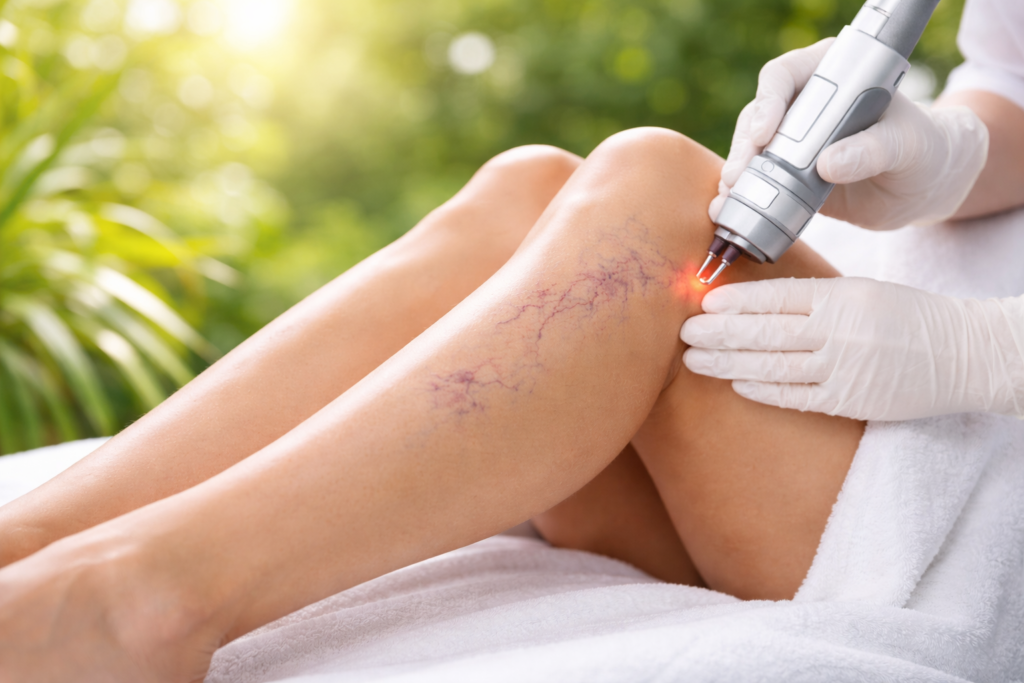
Spider veins, reticular veins, varicose veins: understanding the difference
The term “small leg veins” can refer to different conditions, which do not always require the same approach:
- Spider veins / telangiectasias: fine, very superficial “web-like” vessels.
- Reticular veins: slightly larger, bluish, subcutaneous veins.
- Varicose veins: larger, dilated veins that may bulge and can reflect more significant venous insufficiency.
This distinction matters because it influences both the treatment choice and whether a venous work-up is advisable.
When is a venous ultrasound (duplex Doppler) recommended before treatment?
In some situations, a more complete vascular evaluation is preferable—especially if a deeper venous issue is suspected. A duplex Doppler ultrasound may be recommended to guide the strategy and to avoid treating only the surface if an underlying venous reflux is present.
Situations that may require a thorough medical assessment include, for example:
- skin changes (eczema, hyperpigmentation, fragility, ulceration)
- significant pain, swelling, or rapid worsening
- history of phlebitis / thrombosis
- clearly bulging varicose veins
What treatment options are available for spider veins?
01
Sclerotherapy: a reference technique
Sclerotherapy involves injecting a sclerosing solution into the vein to help it gradually close. It is widely used for leg veins, including spider veins and certain reticular veins, depending on the clinical examination.
02
Transcutaneous vascular laser: helpful for certain small vessels
A vascular laser can be particularly useful when vessels are very fine or depending on the pattern of the network. In our practice, indications may include a Nd:YAG 1064 nm laser (case-by-case, following medical assessment), especially for some small veins that are more resistant.
03
Combined approaches (case by case)
In selected cases, a combined strategy using sclerotherapy + laser may be discussed, particularly for mixed networks with different vessel diameters. The goal is to improve overall uniformity while respecting medical indications.
How treatment is managed at Centre Biolaser
Our approach is structured into three steps:
Treatment sessions
The number of sessions depends on the extent, color, vessel diameter, and underlying venous context. Several spaced sessions may be required.
Mandatory medical consultation
Clinical examination, assessment of vein type, medical history, discussion of options, and—if needed—recommendation for a duplex Doppler.
Personalized treatment plan
Choice of technique: laser, sclerotherapy, or referral for vascular assessment if necessary.
Aftercare and precautions
Post-treatment instructions vary depending on the technique, but commonly include:
- light activity / walking (often encouraged)
- avoiding intense heat (hot baths/sauna) and sun exposure on the treated area for a defined period
- local monitoring (temporary redness, bruising, small crusts may occur depending on technique)
We provide written aftercare instructions tailored to your case.
Possible side effects
As with any medical procedure, risks exist: transient discomfort, redness, bruising, pigment changes, small crusts, more rarely superficial burns/scarring, and rare vascular complications depending on context and technique. Safety relies on careful patient selection, a complete medical assessment, and treatment performed by a qualified practitioner.
Spider veins on the legs can often be treated effectively, but the key is choosing the right indication: identifying the type of veins and ruling out more significant venous insufficiency when suspected. At Centre Biolaser, we prioritize a medical approach—mandatory consultation, an individualized strategy (vascular laser and/or sclerotherapy), and prevention advice to support longer-lasting results.
👉 Appointments: via Doctolib (Centre Biolaser) or biolaser.fr.